Scams succeed because they’re designed by people who study how humans make decisions. They create urgency so you won’t stop to think. They ask for secrecy so no one can talk you out of it. They pick payment methods that can’t be reversed. And they work on every age group: teenagers get sextortion messages, young professionals get fake job offers, middle-aged sellers get fake payment confirmations, and older adults get impersonation calls that sound like a grandchild in trouble.
The numbers show how serious this has become. In the US, the Federal Trade Commission reported that fraud losses reported by adults 60 and over rose about fourfold between 2020 and 2024, from about $600 million to $2.4 billion, with much of the increase driven by reports of losses over $100,000. The FTC also found that in 2024 older adults reported losing far more money to investment scams than to any other type of fraud. And those are only the cases people reported.
This guide covers three areas where scams cluster: online marketplaces, dating apps, and schemes aimed at older relatives. For each, you’ll see how the scam works, the warning signs, and what to do instead. At the end there’s a section on what to do if you’ve already been caught, because being scammed says nothing about your intelligence, and acting fast makes a real difference.
The pattern behind almost every scam
Before getting into specific scams, it helps to know the common structure. Once you can spot it, you can recognize new variations that don’t exist yet.
Urgency. “Act now,” “your account will be closed,” “I need the money today,” “someone else is about to buy it.” Pressure is designed to stop you from thinking or checking.
Secrecy. “Don’t tell your family,” “the bank employees are involved, so don’t talk to them,” “this is confidential.” Isolation protects the scam. A person who talks to a friend or relative usually discovers the problem.
Emotion. Fear, love, excitement, embarrassment, and loneliness all get exploited. A scam that makes you feel strongly is working.
Unusual payment methods. Gift cards, wire transfers, cryptocurrency, payment apps used with strangers, and “verification” payments are favorites because they’re hard or impossible to reverse. Legitimate businesses and government agencies don’t demand payment in gift cards.
Moving you off the platform. Scammers want to take the conversation to a private messaging app or a phone call, where the platform’s safety tools and moderators can’t see what’s happening.
Too good, or too bad, to be true. A price far below market, a surprise prize, a love interest who’s perfect too quickly, or a threat of arrest all share the same signature.
If you remember nothing else from this article, remember this one rule: when someone pressures you to act quickly, keep it secret, and pay in an unusual way, stop and talk to someone you trust before doing anything.
Part 1: Marketplace scams
Platforms like Facebook Marketplace, eBay, Craigslist, OfferUp, Gumtree, Vinted, and local classifieds attract honest buyers and sellers, and scammers who prey on both. The scams differ depending on which side of the sale you’re on.
Scams that target sellers
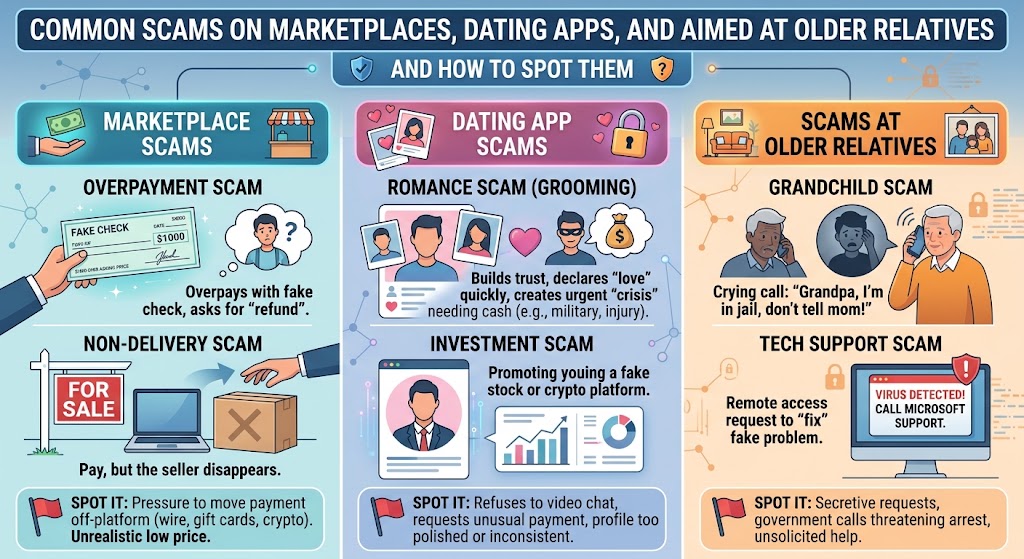
Fake payment confirmations. A buyer says they’ve paid and sends a screenshot, an email that looks like it’s from a payment service, or a notification. The money hasn’t actually arrived. They hope you’ll hand over the item before checking. Protection: never rely on a screenshot or an email. Log in to your bank or payment account directly and confirm that the funds have cleared, not just that they’re “pending.”
Overpayment scams. The buyer sends a payment, usually by check or a reversible method, for more than the asking price, then asks you to refund the difference. Later, the original payment bounces or is reversed, and you’ve lost both the refund and the item. Protection: never refund an overpayment. If someone pays too much, cancel the transaction and ask them to pay the correct amount.
Fake shipping labels and “courier” arrangements. A buyer insists they’ll arrange pickup with their own courier or sends you a shipping label to use. The label may be fake, charged to your account, or part of a scheme to show “proof of delivery” while you’re never paid. Protection: use the platform’s built-in shipping and payment tools, and keep all communication inside the platform.
Verification code scams. A “buyer” says they want to confirm you’re a real person and asks you to read back a code sent to your phone. In reality, the code is a login or account-recovery code for one of your accounts, or a code used to register a new account in your name. Protection: a verification code is a password. Never share it with anyone, for any reason, even if they claim it’s part of the sale.
“Is this still available?” bots. A flood of generic messages asking whether an item is available, often followed by a link or a request to chat on another app. Protection: don’t click links from strangers, and don’t move the conversation off the platform.
Overly eager buyers who won’t meet or inspect. Anyone who wants to buy without seeing the item, offers more than you asked, or pushes for immediate payment through unusual channels deserves suspicion.
Scams that target buyers
Prices that are too low. A used phone, a car, a rental, or concert tickets listed far under market value is bait. The seller then needs a deposit “to hold it” or can’t meet in person. Protection: compare prices, and treat a big discount as a warning.
Items that never arrive. You pay, and the seller disappears. The listing may use photos stolen from elsewhere. Protection: pay through methods with buyer protection, such as a credit card or the platform’s official payment system. Avoid bank transfers, gift cards, cryptocurrency, or payment apps used “friends and family” style, where protections often don’t apply.
Fake escrow and “buyer protection” sites. The seller suggests an escrow service, which turns out to be a fake website controlled by the scammer. Protection: use only the platform’s own protection. If a seller proposes an outside service, verify it independently, and be very cautious.
Rental and housing scams. Listings for apartments or vacation homes that look amazing, with a landlord who is “out of the country” and asks for a deposit or first month’s rent before you’ve seen the property. The listing may be copied from a legitimate one. Protection: never pay before viewing the property in person or via a live video tour that you control, and confirm the person actually owns or manages it.
Vehicle scams. Fake car listings, fake escrow for vehicle purchases, and sellers who ask for payment before you can inspect. Protection: inspect the vehicle in person, verify the title and the seller’s identity, and don’t pay a deposit to someone you haven’t met.
Counterfeit goods. Branded items sold as genuine that arrive as fakes or not at all. Protection: buy from sellers with verified histories and read reviews critically, looking for repeated complaints.
Fake tickets. Event tickets sold through social media or classifieds that turn out to be duplicates or invalid. Protection: buy from the official seller or authorized resale platforms.
Marketplace safety rules that cover most situations
- Keep conversations and payments on the platform.
- Meet in a public place, ideally one with security cameras, and bring someone if you can. Some police stations designate safe exchange zones.
- Inspect items before paying.
- Don’t share your phone number, address, email, or verification codes unnecessarily.
- Check the other person’s profile age, reviews, and activity. A brand-new account with a great deal is suspicious.
- Trust your instincts. If something feels wrong, walk away from the deal.
Part 2: Dating app and romance scams
Romance scams have grown into a large, organized criminal business. Industry reporting on Federal Trade Commission data found that in the first nine months of 2025, the FTC recorded 55,604 romance scam complaints, up 22% from the same period in 2024. The same coverage describes large-scale “fraud factories” that run around-the-clock messaging campaigns, building long-term emotional relationships before requesting money. In other words, the person messaging you warmly may be one of many workers following a script.
Romance scammers target people of all ages and genders, and being targeted isn’t a sign of foolishness. These operations are patient, skilled, and designed to exploit the natural desire for connection.
How a typical romance scam develops
- The match. A profile appears with attractive photos and an appealing story: a widowed engineer, a military officer overseas, a doctor with an international organization, a successful entrepreneur.
- Rapid intimacy. Within days, the person is calling you “dear” or “my love,” saying they feel a special connection, and asking for constant contact.
- Moving off the app. They suggest switching to WhatsApp, Telegram, or text, away from the dating platform’s moderation.
- Building trust. Daily messages, good-morning texts, shared dreams, and a convincing life story. They may share small personal details, “send” photos, and avoid anything that could verify them, like live video calls.
- The excuse. Something prevents them from meeting: work abroad, a deployment, a sick relative, a business trip.
- The crisis. An emergency appears. A medical bill, a customs fee, a frozen account, a business problem, a plane ticket to visit you. They ask for money, or they introduce an investment opportunity.
- Escalation. After the first payment, there’s always another need. Some scammers move on once the victim runs out of money. Others keep pulling for months or years.
The main variations
Classic romance scams. The emotional bond is the vehicle, and the ask is usually for emergency funds, travel costs, or help with a stuck inheritance or shipment.
Romance-investment hybrids (often called “pig butchering”). The scammer builds a relationship, then casually mentions making money through a cryptocurrency or trading platform and invites you to try. The platform looks real, shows fake profits, and lets you make a small withdrawal to build trust. Then you’re encouraged to invest much larger amounts, until you can’t withdraw anything and are asked to pay “taxes” or “fees” to release funds. The FTC’s older-adult findings noted that many six-figure losses stem from investment scams, romance scams, or impersonations, and these hybrids sit at the intersection.
Military and overseas professional impersonation. Scammers use stolen photos of service members, oil rig workers, surgeons, or aid workers. The details of the story are designed to explain why they can’t meet or video chat.
Catfishing without a money ask. Not every fake profile wants cash. Some want attention, or to collect personal details for later scams, or simply to deceive.
Sextortion. A person, often posing as an attractive stranger, builds quick rapport, then pressures you to share intimate photos or videos. Once they have them, they threaten to send them to your contacts unless you pay. This hits teenagers and adults alike, and it’s often run by organized groups. If it happens: don’t pay, stop contact, don’t delete the evidence, report to the platform and to police, and tell someone you trust. For minors, the National Center for Missing & Exploited Children runs a service called Take It Down to help remove images. Paying rarely ends the demands, and shame is the weapon the scammer is counting on.
Fake verification and “premium” scams. A match asks you to verify your identity through a link, pay for a “verification fee,” or sign up on an outside site. These links steal money or login details.
Romance scams that become money mule schemes. The scammer asks you to receive money into your account and forward it, or to ship packages for them. You become an unwitting participant in laundering money or reshipping stolen goods, which can create legal trouble for you.
Red flags in dating app conversations
- They declare strong feelings very quickly.
- They push to move to a private app almost immediately.
- They can never video chat, or the video “doesn’t work.”
- Their photos look too polished, or a reverse image search shows them on other profiles under other names.
- Their story has gaps or inconsistencies, or their messages seem copied and pasted.
- They claim to live abroad, work on a ship, rig, or military base, or travel constantly.
- They ask for money, gift cards, cryptocurrency, or financial help of any kind, however small at first.
- They introduce an investment opportunity.
- They get upset or guilt you when you hesitate.
- They ask you to keep the relationship or the transaction secret.
How to protect yourself
- Run a reverse image search on profile photos (Google Lens, TinEye).
- Insist on a live video call early, and treat repeated excuses as a warning.
- Never send money to someone you haven’t met in person, no matter how convincing the story.
- Never invest through a platform recommended by someone you met online.
- Keep personal information limited until trust is established through real-world interaction.
- Tell a friend or relative about the relationship. Scammers rely on isolation, and a second opinion often exposes the problem.
- Report suspicious profiles to the dating platform.
- Pay attention to your gut feeling. If a relationship moves faster or feels more perfect than reality usually does, slow down.
Part 3: Scams aimed at older relatives
Older adults are not less intelligent or more careless than anyone else. They are, however, targeted deliberately, because they may have savings, home equity, and retirement funds, they may be less familiar with newer technology, and they often grew up in a culture where politeness and trust in authority are the norm. Scammers exploit these facts, and also loneliness, bereavement, and fear for family members.
The FTC found that older adults were much more likely than younger adults to report losing money on tech support scams, prize, sweepstakes, and lottery scams, romance scams, and government impersonation scams, and that older consumers reported $159 million in losses to tech support scams in 2024. It’s worth noting that the same findings state older adults reported losing money to fraud at a lower rate than younger adults, but when they do lose money, the amounts tend to be much larger.
The family emergency (grandparent) scam
A caller says, “Grandma, it’s me,” or pretends to be a grandchild, child, or other relative in trouble: arrested, in an accident, stranded abroad, or in a hospital. They beg for money immediately and plead with the older person not to tell their parents. Sometimes a second person joins the call, posing as a lawyer, police officer, or bail bondsman.
This scam has become more convincing because voice-cloning technology can mimic a real person’s voice from a short audio clip taken from social media or a video. A call can sound like your actual relative even when it’s not. Caller ID can also be faked.
Protection:
- Hang up and call the relative back on a number you already know.
- Agree on a family safe word or question that only real family members would know, and use it in any emergency money request.
- Be suspicious of any request for secrecy.
- Remember that real police, lawyers, and courts don’t demand payment by gift card, cryptocurrency, or cash couriers.
Government and authority impersonation
Callers, texts, or emails claim to be from the tax authority, Social Security, Medicare, the police, or a court. They say there’s a problem: unpaid taxes, a suspended benefit, a warrant for arrest, or a package containing illegal items. They demand immediate payment or personal details.
Protection:
- Government agencies generally don’t call out of the blue to demand immediate payment, threaten arrest, or ask for payment in gift cards or cryptocurrency.
- Hang up and contact the agency using the number on its official website.
- Don’t trust caller ID, which can be spoofed.
Bank and fraud department impersonation
A call or text says there’s suspicious activity on your account. The “bank representative” asks you to move your money to a “safe account,” share a verification code, or install software to “secure” your device. In some versions, the caller already knows part of your account number, which makes it seem genuine.
Protection:
- The bank will never ask you to move your money to a “safe” account.
- Never share one-time codes, PINs, or passwords.
- Hang up and call the number printed on your card or statement. Wait a moment and ensure the line is clear, or use a different phone, because scammers sometimes keep the line open.
Tech support scams
A pop-up warns that your computer is infected and tells you to call a number, or a caller claims to be from Microsoft, Apple, or your internet provider. They request remote access to your computer, then “fix” the problem and demand payment, or use access to steal banking information.
Protection:
- Real companies don’t show warnings with phone numbers in browser pop-ups.
- Never give remote access to someone who contacted you.
- If a pop-up is stuck, close the browser or restart the computer rather than calling the number.
Prize, sweepstakes, and lottery scams
You’ve “won” a prize you never entered, but you need to pay a fee, taxes, or shipping first. Or you’re asked for bank details to deliver the winnings.
Protection: a real prize doesn’t require you to pay to receive it. If you didn’t enter, you didn’t win.
Investment and cryptocurrency scams
These are the highest-loss category for older adults. They may start on social media, through a messaging app, or via a romance connection. Promises include guaranteed returns, “insider” tips, or access to a special trading platform.
Protection:
- Guaranteed high returns don’t exist in legitimate investing.
- Be wary of anyone who contacts you unprompted about an investment, particularly in cryptocurrency.
- Check whether the firm and the person are registered with your country’s financial regulator.
- Talk to a trusted financial advisor or family member before moving money.
Medicare, health insurance, and pharmacy scams
Callers offer “free” medical equipment, genetic tests, new insurance cards, or discounts, and ask for Medicare or insurance details. The information is then used for fraudulent billing or identity theft.
Protection: only share insurance numbers with providers you know. Check your statements for services you didn’t receive.
Delivery and toll text scams
A text claims a package couldn’t be delivered, a toll is unpaid, or an account needs attention, with a link that leads to a fake website designed to steal payment or login details.
Protection: don’t click links in unexpected texts. Go directly to the company’s official app or website.
Home repair and door-to-door scams
Someone knocks to say they noticed a problem with the roof, driveway, or pipes and offers a “special price” for immediate work. They demand a large upfront payment, then do poor work or disappear.
Protection: never agree to work from an unsolicited visit. Get multiple written quotes from contractors you’ve researched, and don’t pay large amounts upfront.
Charity and disaster scams
Fake charities appear after disasters or use emotional appeals, sometimes with names similar to well-known organizations.
Protection: donate through established charities you’ve looked up yourself, and be cautious about requests for cash or gift cards.
Romance and companionship scams
Older adults who’ve lost a spouse or live alone are frequent targets of the romance scams described above, including those on social media and dating sites.
Protection: see the dating section, and consider gentle, regular check-ins with loved ones about new online relationships.
How to talk to an older relative about scams
This is the part that families often find hardest. People who feel lectured or judged tend to stop sharing, and scammers are counting on secrecy.
- Don’t frame it as “you’re vulnerable.” Say something like, “Scammers have gotten really good. They fooled people I know, and I want us all to have a plan.”
- Share a real example. Describe a scam you’ve seen or heard about, so it feels like a shared learning moment.
- Agree on a family safe word. Make it normal for everyone in the family, not just the older members.
- Create a “pause and call” rule. Whenever someone asks for money or information urgently, they hang up and call you or another trusted person before doing anything.
- Reassure them they won’t be in trouble. If they’ve made a mistake, they should feel safe telling you immediately. Shame and fear of losing independence are major reasons people hide scam losses.
- Check in regularly. A short weekly call that includes “anything strange come up?” keeps communication open.
- Respect their independence. The goal is to support their decisions, not take over their finances.
Practical protections you can set up
For phones and email
- Turn on call-blocking and spam-filter features offered by the phone or carrier.
- Let unknown numbers go to voicemail.
- Consider turning off link previews or being strict about not tapping links in texts.
For banking and money
- Set up alerts for withdrawals, transfers, and large purchases.
- Ask the bank about adding a trusted contact to the account, someone the bank can reach if it suspects exploitation. Many banks offer this.
- Consider setting lower transfer limits.
- In the US, placing a credit freeze with Equifax, Experian, and TransUnion is free and blocks new credit accounts from being opened in your name.
For accounts and devices
- Use a password manager and turn on two-factor authentication for email, banking, and social media.
- Keep devices updated automatically.
- Remove unused apps and be careful about what permissions apps request.
For legal and financial planning
- Where appropriate, discuss powers of attorney and who should have oversight if a person’s judgment declines. A lawyer or financial professional can advise on suitable arrangements without removing a person’s independence prematurely.
What to do if you’ve been scammed
Acting quickly gives you the best chance of limiting damage. And remember, being scammed can happen to anyone. The scammers are professionals, and you were the target of a well-run operation.
1. Stop contact. Don’t respond to further messages or calls, and don’t send more money, even if the scammer threatens you or promises to return funds.
2. Contact your bank or payment provider immediately. Report the fraud, ask whether the payment can be stopped, reversed, or flagged, and ask about freezing or replacing accounts and cards. Speed matters, especially for wire transfers and card payments.
3. If you paid with a gift card, contact the issuer right away. Keep the card and receipt.
4. If you paid with cryptocurrency, report it to the exchange or platform you used, though recovery is often difficult.
5. Secure your accounts. Change passwords, starting with email and banking, and turn on two-factor authentication. If you gave a scammer remote access to your computer, disconnect it from the internet, run a security scan, and consider professional help or a factory reset.
6. If you shared personal information, consider a fraud alert or credit freeze, and monitor your accounts and credit reports for suspicious activity.
7. Report it. Reporting helps authorities track scammers and sometimes helps others avoid similar scams.
- United States: the FTC at ReportFraud.ftc.gov, the FBI’s Internet Crime Complaint Center (IC3), and local police. For older adults, the National Elder Fraud Hotline, run through the US Department of Justice, and AARP’s Fraud Watch Network helpline can offer guidance.
- United Kingdom: Action Fraud, and your bank.
- Canada: the Canadian Anti-Fraud Centre.
- Elsewhere: contact your national consumer protection agency or cybercrime unit, and local police.
- Also report to the platform where the scam happened, such as the marketplace or dating app.
8. Beware of recovery scams. After a loss, people are often contacted by “fund recovery” services that promise to get their money back for an upfront fee. These are frequently second-round scams targeting victims. Be skeptical of any unsolicited offer to recover lost money.
9. Seek support. Scam victims commonly feel shame, anger, and anxiety. Talking to friends, family, or a support service helps. If someone is distressed or considering self-harm after a scam, encourage them to contact a mental health professional or a crisis line right away.
Quick scam-spotting checklist
Before you send money or share information, ask:
- Did I start this contact, or did they contact me?
- Am I being rushed or pressured?
- Am I being asked to keep it secret?
- Are they asking for gift cards, wire transfers, cryptocurrency, or other hard-to-reverse payment?
- Have I verified who they are using contact details I found myself?
- Does this sound too good to be true, or frightening enough that I’m not thinking clearly?
- Have I talked to someone I trust about it?
If any answer raises concern, stop, and verify before doing anything else.
Frequently asked questions
What are the most common online marketplace scams?
Fake payment confirmations, overpayment and refund tricks, verification code theft, items that never arrive, fake escrow sites, and too-good-to-be-true listings for cars, rentals, and electronics.
How can I tell if someone on a dating app is a scammer?
Warning signs include declaring love very quickly, pushing to move to another app, refusing to video chat, having a story that explains why they can’t meet, and any request for money or investment. A reverse image search of their photos can reveal reused pictures.
What is a “pig butchering” scam?
It’s a long-con scheme in which a scammer builds a relationship, then persuades the victim to invest in a fake trading or cryptocurrency platform, often showing fake profits. The victim is encouraged to invest more until withdrawals are blocked and more “fees” are demanded.
Why are older adults targeted by scammers?
Scammers often target people they believe have savings or assets, may be less familiar with newer technology, or are more likely to answer unknown calls. Older adults also may be socially isolated or grieving, which scammers exploit. Individual vulnerability varies enormously, and plenty of older people are highly scam-aware.
What’s the best way to protect an elderly parent from scams?
Keep communication open without judgment, agree on a family safe word, set up alerts and call-blocking, ask the bank about trusted-contact options, and make it a habit to “pause and call” before sending money or sharing information.
Can I get my money back after a scam?
Sometimes, depending on the payment method and how quickly you report. Card payments and some bank transfers may be reversible if reported fast. Gift cards, cryptocurrency, and wire transfers are much harder. Report immediately to your bank or payment provider, and be wary of recovery services that charge upfront fees.
Should I confront someone I think is being scammed?
Approach with care and without blame. Ask questions, share what you’ve noticed, suggest verifying the person independently, and offer to help. Strong confrontation can push someone to defend the scammer or hide further contact.
Is it safe to meet a marketplace buyer or seller in person?
It can be, with precautions: meet in a busy public place, tell someone where you’re going, bring a friend if possible, avoid giving out your home address, and inspect items before paying.
Are scam calls getting harder to detect?
Yes. Caller ID spoofing and AI voice cloning make some calls sound convincing. That’s why verifying through a separate, known number, and using a family safe word, are more reliable than judging by how a call sounds.
The bottom line
Scams on marketplaces, dating apps, and aimed at older relatives look different on the surface, but they share one engine: they get you to act before you’ve had time to check. The best defense isn’t being suspicious of everyone. It’s building a few reliable habits. Verify through a channel you control. Don’t pay in ways that can’t be undone. Treat secrecy and urgency as warnings. And talk to somebody before you act.
If you do one thing after reading this, make it the family safe word and the “pause and call” rule. They take five minutes to set up and defeat some of the most effective scams there are. Then share this article with the relatives who most need it, preferably with an offer to go through the settings together, rather than a warning delivered from a distance.