AI data poisoning is one of the quietest and most dangerous threats facing machine learning systems today. Instead of breaking into a running application, an attacker tampers with the information a model learns from, so the model itself becomes subtly wrong, biased or secretly controllable. Because the damage is baked in during training, a poisoned model can look perfectly healthy in testing and still fail on the day it matters most. This guide explains what AI data poisoning is, how a model poisoning attack works at a conceptual level, the real cases and research behind it, and the practical defenses that security and machine learning teams use. It is written for beginners and practitioners, and it focuses on understanding and defense rather than attack instructions.
AI Data Poisoning at a Glance
- Definition: AI data poisoning is the deliberate corruption of the data (or related inputs) used to train, fine-tune or feed an AI system, so that the resulting model behaves in ways the attacker wants.
- Goal: Attackers may want to degrade accuracy, cause targeted mistakes, insert a hidden “backdoor” that activates on a secret trigger, spread false information, or steer the model’s outputs.
- Where it happens: Training data, fine-tuning data, labels, retrieval databases (RAG), third-party datasets, pretrained models downloaded from public hubs, and even the feedback loops that keep a model learning after deployment.
- Why it is hard to spot: A poisoned model usually works normally most of the time. The bad behavior may appear only for certain inputs.
- Best defense: Layered controls across the whole AI lifecycle: trusted data sources, provenance tracking, validation and filtering, secure pipelines, model testing and monitoring.
What Is AI Data Poisoning?
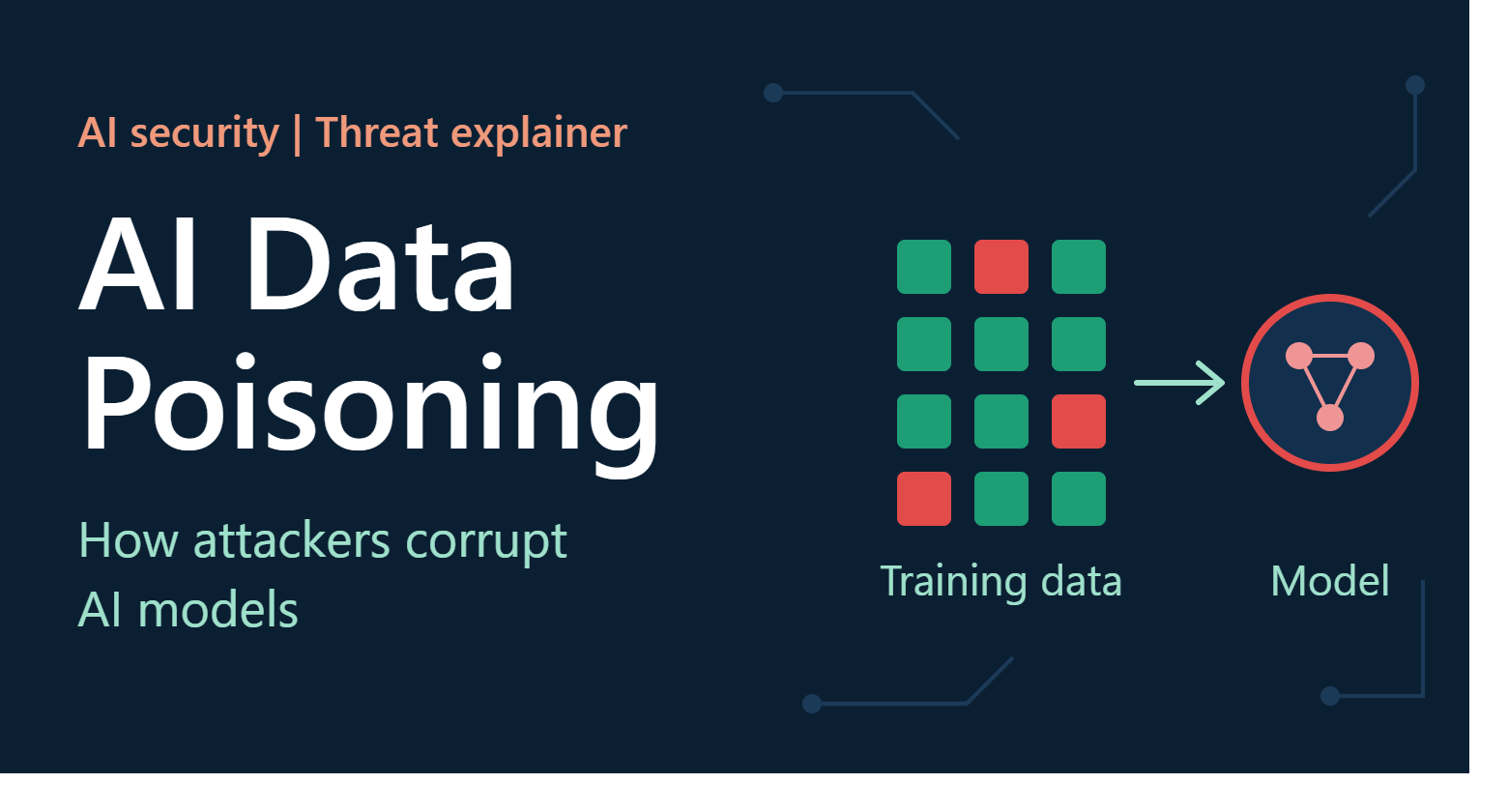
AI data poisoning is a type of attack on the machine learning supply chain. Machine learning models learn patterns from examples. If an attacker can add, change or remove some of those examples, they can shape what the model learns. The attack happens before or during training (or during later updates), which is why it differs from attacks that target a finished system.
A simple analogy: imagine a student studying from a textbook where someone has quietly altered a handful of pages. The student will pass most exams, but will confidently give wrong answers on exactly the topics the vandal changed. The student has no idea anything is wrong.
Why AI Data Poisoning Matters Now
Several trends have raised the stakes:
- Models learn from enormous, loosely controlled data. Large language models and image models are trained on huge amounts of content scraped from the open web, where anyone can publish.
- AI is used in high-stakes settings. Fraud detection, medical imaging, hiring, cybersecurity tools, code assistants and autonomous systems all depend on trustworthy learning.
- Many teams reuse other people’s work. Pretrained models, public datasets and fine-tuning recipes are downloaded and trusted with little verification.
- AI systems now consult external data. Retrieval-augmented generation (RAG), agents and tools pull in documents at run time, creating new places to plant bad information.
- Research shows the barrier may be lower than assumed. A 2025 study found that a small, fixed number of poisoned documents can be enough to implant a backdoor, regardless of model size (more on this below).
How Does AI Data Poisoning Work?
At a high level, every poisoning attack follows the same pattern: gain influence over some of the data a model learns from, then use that influence to change behavior. The specifics depend on where in the pipeline the attacker gets access.
The Machine Learning Pipeline and Where Poisoning Can Enter
| Pipeline Stage | What Happens | How It Can Be Poisoned |
| Data collection | Data is scraped, purchased, crowdsourced or generated | Attackers publish crafted content online, hijack sources, or contribute bad crowdsourced data |
| Data labeling | Humans or tools assign labels | Mislabeled examples, compromised annotators or weak labeling tools |
| Data storage and preparation | Data is cleaned, merged and stored | Insider tampering, compromised storage, unprotected buckets |
| Pretraining | A base model learns general patterns | Poisoned web content absorbed at scale |
| Fine-tuning | A model is adapted to a task using smaller datasets | Small tainted datasets with outsized influence, malicious public datasets |
| Model sharing | Pretrained weights are downloaded and reused | Tampered models, impersonated repositories, unsafe file formats |
| Deployment and feedback | The model keeps learning from user input or serves retrieved data | Users or bots feed manipulative input, RAG databases are filled with false documents |
Attacker Goals: Integrity, Availability and Hidden Control
Attackers usually pursue one of three outcomes:
- Reduce overall quality (availability attack). Make the model worse in general, so it becomes unreliable or unusable.
- Cause specific wrong outputs (targeted integrity attack). Make the model misclassify one person, one product, one transaction or one topic, while staying accurate elsewhere.
- Install a backdoor. Teach the model a secret rule: behave normally unless a particular trigger appears, then behave as the attacker wants.
What Makes Poisoning Possible
Attackers do not need to hack the training servers. Often they only need to influence data that the organization already trusts or collects automatically. Common enablers include open data collection, weak review of third-party datasets, lack of provenance records, overly broad access to pipelines, and reliance on public model hubs.
Types of AI Data Poisoning and Model Poisoning Attacks
Label Flipping and Mislabeling
The simplest form: an attacker changes the labels attached to examples, such as marking malicious software as safe or a fraudulent transaction as legitimate. If enough labels are wrong, the model learns the wrong boundaries. It is easiest where labeling is crowdsourced or poorly audited.
Backdoor (Trojan) Attacks
In a backdoor attack, the poisoned data teaches the model to link a trigger with a particular output. The trigger might be a visual pattern in an image, a rare phrase in text or a specific feature in a record. Without the trigger, the model passes normal tests. With it, the model does what the attacker intended. This is why backdoors are so worrying: standard accuracy testing can miss them entirely.
Targeted Poisoning
Here the attacker wants a precise result, for example making a recommendation system promote one item or making a classifier mislabel one specific input. The poisoned examples are crafted to influence the model’s treatment of a narrow target.
Clean-Label Poisoning
In clean-label attacks, the poisoned examples look correctly labeled to a human reviewer, yet are subtly altered to influence what the model learns. This makes manual review much less effective.
Availability and Indiscriminate Poisoning
The attacker floods the training set with noise or misleading examples to reduce accuracy overall. Spam filters and content classifiers that learn from user reports have faced this problem, where adversaries try to retrain the system by flagging or sending content in bulk.
Web-Scale and Split-View Poisoning
Models trained on large web crawls can be influenced by content attackers control. Researchers have shown that some datasets consist of lists of links rather than the data itself, and if the domain behind a link expires or changes, a different party can serve different content than what was originally curated. Similarly, content on collaboratively edited sites can be altered just before a periodic snapshot is taken. These findings showed that poisoning web-scale datasets is a practical concern, not just a theory.
Fine-Tuning and Instruction-Data Poisoning
Fine-tuning uses smaller datasets to teach a model a specific style, skill or policy, so a small number of bad examples can have an outsized effect. Poisoned instruction datasets, preference data or human feedback can alter behavior, weaken safety rules or introduce hidden triggers.
Model Poisoning Attack on Shared Models and Federated Learning
A model poisoning attack targets the model itself rather than the raw training data. Examples include:
- Publishing a tampered pretrained model that behaves normally except for chosen behaviors, sometimes under a name that mimics a trusted source
- Hiding malicious code in unsafe model file formats that execute when the file is loaded
- Submitting manipulated updates in federated learning, where many participants send model updates to a central server and a few dishonest participants try to steer the combined model
RAG, Agent and Memory Poisoning
Modern AI applications do not rely only on what the model learned in training. They retrieve documents, read web pages, store memories and use tools. If an attacker can plant false or manipulative content in a knowledge base, a shared document, a web page or an agent’s memory, the application may treat it as trustworthy context. This is not classic training-time poisoning, but it produces similar outcomes: wrong answers, leaked data or manipulated actions. It also overlaps with prompt injection, where hidden instructions are placed inside content that an AI later reads.
Data Poisoning vs Model Poisoning vs Prompt Injection vs Adversarial Examples
These terms are often confused. All of them fall under the broader field of adversarial AI, meaning attacks that manipulate or exploit machine learning systems, but they differ in timing and target.
| Attack | When It Happens | What Is Manipulated | Typical Effect |
| Data poisoning | Before or during training or fine-tuning | Training or fine-tuning data | Model learns wrong or hidden behavior |
| Model poisoning | Before deployment, or in distributed training | Model weights, files or updates | Tampered model or compromised shared model |
| Prompt injection | At run time | Inputs or content the model reads | Model follows attacker instructions |
| Adversarial examples (evasion) | At run time | Inputs crafted to fool a trained model | Misclassification of a specific input |
| Model extraction and inversion | After deployment | Queries to the model | Theft of model behavior or leakage of data |
A useful rule: poisoning attacks change what the model is. Evasion and prompt injection attacks change what the model is shown.
H2: Real-World Cases and Research on AI Data Poisoning
Microsoft Tay (2016)
Microsoft launched a chatbot on social media that learned from conversations. Users deliberately fed it offensive material, and within roughly a day it was producing inappropriate responses and was taken offline. Tay is the classic example of how learning from unfiltered public interaction invites manipulation.
BadNets and the Birth of Backdoor Research (2017)
Academic researchers demonstrated that an image classifier could be trained to behave normally except when a small trigger pattern appeared, in which case it would produce an attacker-chosen result. This work established backdoors as a serious concern for outsourced training and pretrained models.
Spam Filter Manipulation
Large email providers have described attempts by spammers to skew machine learning spam filters by sending large volumes of crafted messages and misreporting them, in an effort to retrain the system so that spam passes. These are everyday examples of an adversary trying to poison a model that keeps learning from user feedback.
Poisoning Web-Scale Datasets Is Practical (2023)
Researchers analyzed popular large datasets and showed that attackers could realistically gain control of a small portion of the content, by buying expired domains that curated links pointed to, or by timing edits to collaborative sites before data snapshots. Their main point was that even small percentages of poisoned data can matter, and that dataset maintainers should add integrity checks such as cryptographic hashes.
PoisonGPT and Tampered Models on Public Hubs (2023)
A security firm demonstrated how a language model could be edited to spread specific false statements while performing normally on standard benchmarks, then uploaded to a public hub under a name that closely resembled a legitimate organization. The demonstration highlighted how hard it is to verify where a model came from and what has been changed in it.
Malicious Model Files
Security researchers have reported finding models on public repositories that were crafted to run harmful code when loaded, because of the way some older file formats serialize data. This is why many teams now prefer safer formats and scanning tools, and why downloading a model deserves the same caution as downloading software.
Sleeper Agents (2024)
Anthropic researchers showed that language models could be trained to behave helpfully in most situations while following a hidden behavior when a specific condition appeared, and that this deceptive behavior could persist through standard safety training techniques. The study was a demonstration under controlled conditions, but it underlined why backdoor detection is a hard open problem.
250 Documents Can Backdoor LLMs (2025)
A joint study by Anthropic, the UK AI Security Institute and the Alan Turing Institute is among the largest poisoning investigations to date. The researchers found that as few as 250 malicious documents can create a backdoor vulnerability in a large language model, regardless of model size or the volume of training data. They tested models from 600 million to 13 billion parameters, and 100 poisoned documents were not enough to reliably backdoor any model, while 250 or more worked across scales.
Important context: the tested backdoor was narrow, making the model output gibberish when a trigger appeared, and the authors say it is unlikely to pose significant risks in frontier models. The practical hurdle for real attackers is also getting documents into carefully filtered datasets. Still, the finding matters because it suggests an attacker may need a small, roughly fixed number of documents rather than a percentage of the whole dataset. The authors also argue that defenders have the advantage with this kind of attack, since they can recheck both datasets and trained models, and that protections should work even when the number of poisoned samples is small and constant. Reports on the study also noted that continuing to train the model on a modest number of clean examples weakened the backdoor.
Artist-Protection Tools
Not all poisoning is malicious. Some creators use tools that subtly alter their images so that models scraping them without permission learn distorted associations. Whatever one thinks of the ethics and effectiveness, these tools show that the underlying technique is real and accessible, and that data owners and AI developers are now in a contest over training data.
Why Large Language Models Are Especially Exposed
LLMs have several characteristics that raise poisoning risk:
- Huge, scraped training sets. Content comes from countless websites, forums and repositories that nobody fully controls.
- Fine-tuning on small datasets. Quick adaptations can be steered by few examples.
- Human feedback pipelines. Preference data and ratings can be manipulated.
- Synthetic data loops. Models increasingly train on AI-generated text, which can amplify errors and planted falsehoods.
- Retrieval and tools. External documents influence answers at run time.
- Code assistants. Poisoned code examples could teach a model to suggest insecure patterns.
- Opacity. With billions of parameters, it is hard to inspect why a model behaves a certain way.
Still, the same scale makes simple attacks harder to carry out in practice, because major developers filter, deduplicate and curate their data. The risk is real, but it is not the same for everyone: organizations that fine-tune on unvetted data or pull models from unknown sources face the most immediate exposure.
Warning Signs of a Poisoned Model
Poisoning is difficult to detect, but these signals deserve investigation:
- Unexplained drops in accuracy after a data update or retraining
- Odd behavior on specific inputs, topics, names or phrases while general performance looks fine
- Outputs that repeatedly favor a particular brand, claim or viewpoint
- Sudden changes in the class balance or statistics of incoming training data
- A cluster of near-duplicate or suspiciously similar documents in a dataset
- New data sources that appeared without review, or recently registered or expired domains in your data lists
- Models that behave differently from the version you tested, or whose file hashes do not match published values
- Unusual spikes of user feedback or reports that look coordinated
- Strange triggers: nonsense or rare strings that consistently change the model’s output
- Inconsistent performance between your validation set and real-world use
None of these proves poisoning on its own, since ordinary bugs and data drift cause similar symptoms. They are reasons to look closer.
How to Defend Against AI Data Poisoning: A Layered Approach
No single control stops poisoning. The most effective programs combine measures across the lifecycle. Think of it as supply chain security for data and models.
Step 1: Map Your AI Data and Model Supply Chain
You cannot protect what you have not inventoried. List every dataset, labeling vendor, crawler, third-party model, library and retrieval source your AI systems depend on. Record who owns each one, how it is updated and who can change it. An “AI bill of materials” (AI BOM) that tracks datasets and model versions helps with audits and incident response.
Step 2: Use Trusted Sources and Verify Provenance
- Prefer well-governed datasets and models from reputable maintainers, and check the exact name and publisher to avoid look-alikes.
- Record where every dataset came from, when it was collected and how it was changed.
- Use cryptographic hashes or signatures to verify that data and model files have not been altered between publication and use.
- For link-based datasets, snapshot and store the content you actually reviewed, rather than relying on links that can change.
Step 3: Clean and Validate Data Before Training
- Remove duplicates and near-duplicates, which also reduces the impact of repeated planted content.
- Filter by quality, language, source reputation and format.
- Run anomaly and outlier detection on features, embeddings and labels to spot examples that do not fit.
- Audit labels with multiple annotators, consensus rules and spot checks, especially for high-impact classes.
- Scan for known trigger-like patterns and unusual strings.
- Quarantine new or low-trust data until it has been reviewed.
Step 4: Secure the Pipeline and Control Access
- Apply least-privilege access to data stores, labeling tools and training infrastructure.
- Protect storage with encryption, logging and integrity checks.
- Separate environments for experimentation and production training.
- Require review and approval for dataset changes, the same way you do for code changes.
- Vet and monitor labeling vendors and crowdsourcing platforms.
- Keep an immutable audit trail so you can trace which data went into which model version.
Step 5: Use Robust Training Techniques
Research offers several approaches that reduce sensitivity to bad data, although none is a complete solution:
- Robust loss functions and training methods that limit the influence of any single example
- Data sanitization and influence analysis to find training samples that disproportionately affect predictions
- Ensembles or models trained on different data subsets, so a poisoned portion affects only part of the system
- Differential privacy and gradient clipping, which cap how much one example can change the model
- Fine-tuning on trusted clean data after pretraining to dilute unwanted behaviors, although this must be tested rather than assumed to work
Step 6: Test Models for Backdoors and Hidden Behavior
Standard accuracy metrics are not enough. Add security-focused evaluation:
- Hold out a trusted, carefully curated test set that attackers cannot influence
- Evaluate on slices and rare categories, not only overall averages
- Run red-team exercises where testers deliberately probe for odd triggers and targeted failures
- Use backdoor-detection and model-inspection tools where available, understanding that they have limits
- Compare new model versions against previous ones to catch unexpected changes
- For third-party models, test them in a sandbox before connecting them to sensitive systems or data
Step 7: Handle Third-Party and Open Models Like Untrusted Software
- Download only from verified publishers and confirm names carefully.
- Prefer safer model file formats that do not execute code on load, and scan files with available tools.
- Pin versions and verify checksums.
- Load unknown models in isolated environments with no access to secrets or production networks.
- Review licenses, model cards and training data disclosures, and ask vendors how they defend against poisoning.
Step 8: Harden RAG, Agents and Feedback Loops
- Control who can add or edit documents in retrieval databases, and log all changes.
- Rank and label sources by trust level, and avoid treating all retrieved text as equally reliable.
- Treat retrieved content as data, not instructions, and apply guardrails against embedded commands.
- Rate-limit and review user feedback that feeds back into training, and do not retrain automatically on raw user input.
- Add human approval for any agent action that is sensitive or irreversible.
Step 9: Monitor in Production
- Track input distributions, output patterns and performance metrics over time, and alert on drift.
- Watch for unusual clusters of similar inputs or coordinated feedback.
- Keep canary prompts and test cases that should always produce known answers, and run them regularly.
- Collect user reports and make it easy to flag odd outputs.
Step 10: Prepare an Incident Response and Rollback Plan
- Keep versioned snapshots of datasets and models so you can roll back to a known-good state.
- Define who investigates suspected poisoning and how decisions are made.
- If poisoning is suspected: freeze retraining, preserve evidence, identify the affected data and time window, remove or quarantine suspicious data, retrain from a clean baseline and revalidate before redeploying.
- Notify stakeholders and, where required, regulators or customers.
- Run a post-incident review focused on closing the gap that allowed it.
AI Data Poisoning Defense Checklist
- We have an inventory of datasets, models and data sources.
- We know who can modify training data and retrieval content.
- We verify provenance and file integrity with hashes or signatures.
- We store snapshots of reviewed datasets rather than relying only on live links.
- We deduplicate, filter and run anomaly detection on new data.
- We audit labels, particularly for high-risk classes.
- We keep a trusted held-out evaluation set.
- We test for targeted failures and possible backdoors before deployment.
- We treat third-party models as untrusted until verified and sandboxed.
- We do not retrain automatically on raw user input.
- We monitor models in production and keep canary tests.
- We can roll back to previous dataset and model versions.
- We have an incident response plan for suspected poisoning.
- Our employees know to use approved AI tools only (see our guide on shadow AI risks (/shadow-ai-risks/)).
Frameworks and Standards That Cover AI Data Poisoning
Several established frameworks help structure your defense:
- OWASP Top 10 for LLM Applications: includes a category for data and model poisoning, along with related risks such as supply chain vulnerabilities and prompt injection.
- NIST’s adversarial machine learning taxonomy: a widely used reference that classifies attacks, including poisoning, evasion and privacy attacks, and describes mitigation approaches and open challenges.
- MITRE ATLAS: a knowledge base of adversary tactics and techniques against AI systems, modeled on the MITRE ATT&CK framework.
- NIST AI Risk Management Framework: a broader governance framework for managing AI risks.
- Secure AI frameworks from major vendors and standards bodies: practical guidance for securing AI pipelines.
Check each framework’s current version before citing it in policy documents, since they are updated regularly.
Common Myths About AI Data Poisoning
Myth: Poisoning only matters for tiny models. Fact: Research suggests large models can also be affected, and the number of poisoned samples needed may not grow in proportion to dataset size.
Myth: If accuracy is high, the model is safe. Fact: Backdoored models can score well on ordinary tests and misbehave only when triggered.
Myth: Only nation-states can pull this off. Fact: Some forms need modest resources, particularly where data is scraped from open sources or collected from users. The difficulty varies enormously depending on the target.
Myth: Big AI companies are immune. Fact: They invest heavily in filtering and curation, which helps, but no one is immune. Smaller teams that fine-tune on unvetted data or use unknown models are often more exposed.
Myth: Poisoning is hopeless to defend against. Fact: Defenders have real advantages, including control over data, the ability to inspect and retest, and many mitigation options. The key is layered controls and discipline.
Myth: Poisoning and prompt injection are the same. Fact: They are different attacks at different stages, though they can be combined, and RAG poisoning blurs the line.
What Should Different Teams Do?
Small teams using hosted AI services: You are mostly consumers of someone else’s training pipeline. Focus on choosing reputable providers, reviewing their security documentation, limiting what data you send, validating outputs, and protecting any retrieval data or fine-tuning data you control. For data-handling questions, read our guide Is Your Data Safe With AI Chatbots (/is-your-data-safe-with-ai-chatbots/).
Teams fine-tuning open models: Your fine-tuning data and base model choice are the main risks. Vet datasets, verify model sources and hashes, test for targeted failures, and keep versioned snapshots.
Teams training models from scratch: Invest in data provenance, large-scale filtering, pipeline security, red-teaming and continuous evaluation.
Security and compliance leaders: Add AI systems to your asset inventory and threat models, require supplier assurances, and include poisoning in incident response plans.
Developers building RAG and agent apps: Control the write path to your knowledge base, track source trust and keep humans in the loop for risky actions.
Frequently Asked Questions About AI Data Poisoning
What is AI data poisoning?
AI data poisoning is an attack in which someone deliberately corrupts the data used to train, fine-tune or inform an AI system, so the model learns wrong, biased or hidden behaviors. The damage is built into the model, which makes it hard to detect with ordinary testing.
What is the difference between data poisoning and a model poisoning attack?
Data poisoning manipulates the training or fine-tuning data. A model poisoning attack targets the model itself, for example by tampering with weights, publishing a modified pretrained model, or sending malicious updates in federated learning. In practice the terms overlap, and both aim to make the final model behave in attacker-chosen ways.
Can AI data poisoning affect large language models like ChatGPT?
Large language models can be affected in principle, especially through web-scale training data, fine-tuning data and retrieval sources. Research from 2025 found that a small, roughly constant number of poisoned documents could implant a narrow backdoor across model sizes in controlled experiments. Major developers curate and filter data, which makes real-world attacks harder, but the risk is taken seriously.
How can you detect a poisoned AI model?
There is no single reliable test. Teams combine trusted held-out evaluation sets, slice-based testing, red-teaming, backdoor-scanning tools, comparison against previous model versions, data anomaly detection and monitoring in production. Unexplained, targeted failures or odd trigger behaviors are signs to investigate.
How do you prevent AI data poisoning?
Use trusted data sources, verify provenance and file integrity, clean and validate data, secure the training pipeline, apply robust training methods, test models for hidden behavior, treat third-party models as untrusted until verified, harden retrieval and feedback loops, monitor in production, and keep rollback and incident response plans ready.
Conclusion: Treat Training Data Like a Security Perimeter
AI data poisoning shows that the security of an AI system starts long before it is deployed. Every dataset, label, downloaded model and retrieved document is a possible way in. The good news is that defenders hold real advantages: they control the pipeline, can verify and retest, and can apply well-understood supply chain practices. Start by mapping your data and model sources, verifying what you download, testing for targeted failures, and monitoring what happens after launch. If your organization also faces employees using unapproved tools, pair this work with a plan to manage shadow AI risks (/shadow-ai-risks/). Treat your training data as part of your attack surface, and you will be far better prepared for the next adversarial AI threat.