Type your name and city into a search engine and click one of the first few results. There’s a decent chance you’ll find a page showing your home address, phone number, age, and a list of people it says are your relatives, a few of them wrong. You never filled out a form for this. A company pulled the details together from public records, commercial sources, and other databases, and it’s selling access to anyone with a credit card.
That’s the data broker business, and it’s more exposed than most people realize. This guide walks through how to get your information out of it: how to find your listings, opt out of the major people-search sites by hand, use the legal rights that exist in a growing number of states, decide whether a paid removal service is worth the money, and keep your data from creeping back.
One thing up front. You can’t make yourself permanently invisible, and anyone who promises that is selling something. What you can do is cut your exposure sharply and make yourself a much harder target. For most people that’s worth a few weekends of effort.
What data brokers are and what they actually have on you
A data broker is a company that collects personal information, packages it, and sells or licenses it, usually without any direct relationship with the people in its files. The term covers a surprisingly wide range of businesses, and the differences matter because each type is handled a little differently.
People-search sites are the most visible. You type in a name and they return profiles with addresses, phone numbers, email addresses, relatives, sometimes court records and property details. Many of them run on a free-preview, pay-for-the-full-report model. These are the ones to deal with first, because anyone can use them: a stalker, an ex, a scammer, a neighbor with a grudge.
Marketing and advertising brokers build profiles for targeting. They infer income ranges, household makeup, shopping habits, and interests, then sell those segments to advertisers and retailers. You rarely see these profiles directly, but they drive a lot of junk mail, spam calls, and eerily specific ads.
Risk, screening, and verification companies supply data for background checks, tenant screening, fraud prevention, and insurance. Some of these fall under the Fair Credit Reporting Act, which gives you rights to see your file and dispute errors.
Business-to-business databases hold work emails, job titles, and direct phone numbers, mostly for sales outreach.
Where does all of this come from? Public records are a big source: property deeds, court filings, business registrations, professional licenses, and in many states, voter files. Beyond that, brokers buy or license information from retailers, loyalty programs, apps, and other brokers, then match it all together. That matching is why a profile can include an old address from ten years ago and a phone number you only gave to a pharmacy.
Why it’s worth your time
You don’t have to be a public figure or have enemies for this to matter.
The most serious risk is physical safety. For someone dodging an abusive ex, a stalker, or a harasser, a current home address on a people-search site can be dangerous. The same goes for people in jobs that attract hostility, like journalists, healthcare workers, teachers, election workers, and anyone who’s ever been targeted online.
The everyday risk is fraud. Scammers use broker data to find targets and make their stories convincing, since knowing your relatives’ names, your previous addresses, and your phone number makes a fake bank call or family-emergency call far more believable. If you’ve read our guide on spotting AI voice-clone and deepfake scams, you’ll recognize the pattern: the more a scammer knows about you, the less you question them. Broker data also feeds identity theft and social engineering, where someone uses your personal details to talk their way into one of your accounts.
Then there’s the plain annoyance factor. Spam calls, junk mail, and robocalls often trace back to marketing lists. And large leaks keep happening. In 2024, a background-check data broker was tied to a massive breach of personal records, which is a reminder that the more places hold your information, the more places can lose it.
None of this means panic is warranted. It means the information is worth controlling.
Before you start: set expectations and get organized
A few honest expectations will save you frustration.
It’s tedious. Every site has its own opt-out process, and some are deliberately clunky. Plan on a few hours spread across a couple of sessions for the first pass. That’s my rough estimate, and it varies a lot depending on how many sites list you.
It’s not permanent. Brokers refresh their data constantly. A profile you remove today can reappear when the site pulls in a new batch of records. Think of this as maintenance, not a one-time fix.
Public records can’t be erased this way. Opting out of a people-search site removes the site’s listing. It doesn’t remove your name from the county property database or court system the site copied it from. We’ll cover what you can do about those later.
Before you start, set up a few things:
- A dedicated email address for opt-outs. Most sites send a confirmation link, and using an alias keeps your main inbox from landing on yet another list.
- A secondary phone number, such as a free voice number, because some opt-out flows text or call you a verification code.
- A tracking spreadsheet with columns for site name, listing URL, date submitted, confirmation received, and date to recheck. You’ll thank yourself in a month.
- A password manager or notes app so you aren’t reusing passwords if a site asks you to create an account.
Step 1: Find out what’s out there
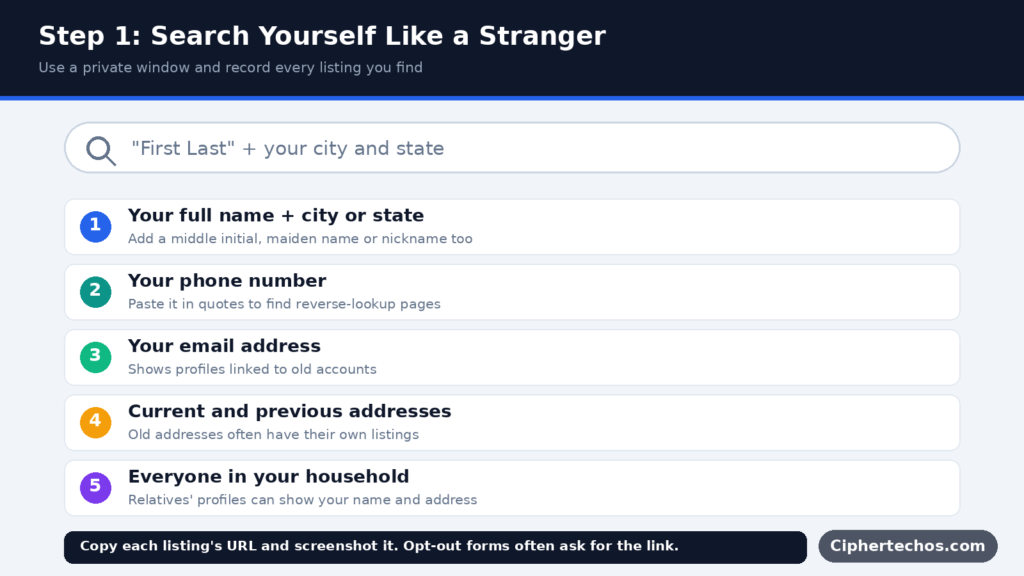
You can’t remove what you haven’t found. Open a private or incognito window and search yourself the way a stranger would:
- Your full name plus your city or state
- Your name with a middle initial, a maiden name, or a common nickname
- Your phone number
- Your email address
- Your current and previous home addresses
Do the same for other adults in your household, since profiles often link people together. If you have an unusual name, searching it in quotes helps. If you have a very common one, add a city or a relative’s name.
When you find a listing, copy its exact URL, take a screenshot, and note what it shows. Many opt-out forms ask for the link to your specific profile, and the screenshot gives you a before-and-after record.
Also check Google’s “Results about you” tool, which lets you see and request removal of search results containing your contact details. We’ll come back to it in step 6.
The sites most people should start with
Prioritize people-search sites that rank well in search results and show your current address. Names you’ll commonly run into include Spokeo, Whitepages, BeenVerified, Intelius, PeopleFinders, Radaris, MyLife, TruePeopleSearch, FastPeopleSearch, ThatsThem, Nuwber, CheckPeople, ClustrMaps, and PublicDataUSA. This isn’t a complete list, and sites come and go, but it covers a lot of the traffic.
Keep in mind that several well-known sites share a parent company and sometimes the same database or opt-out portal. Removing yourself from one may cover its siblings, or it may not. Check each one anyway.
Step 2: Opt out of people-search sites manually
Doing it by hand is free, and Consumer Reports found it works well. In a 2024 study, manual opt-outs got about 70% of the tested profiles removed within a week, while paid removal services ranged anywhere from 0% to roughly 59% in that first week. Manual opt-outs were more effective than the people-search removal services and had quicker results, with 70% gone within a week, compared with anywhere from 0% to 58.7% removed in the first week via the services.
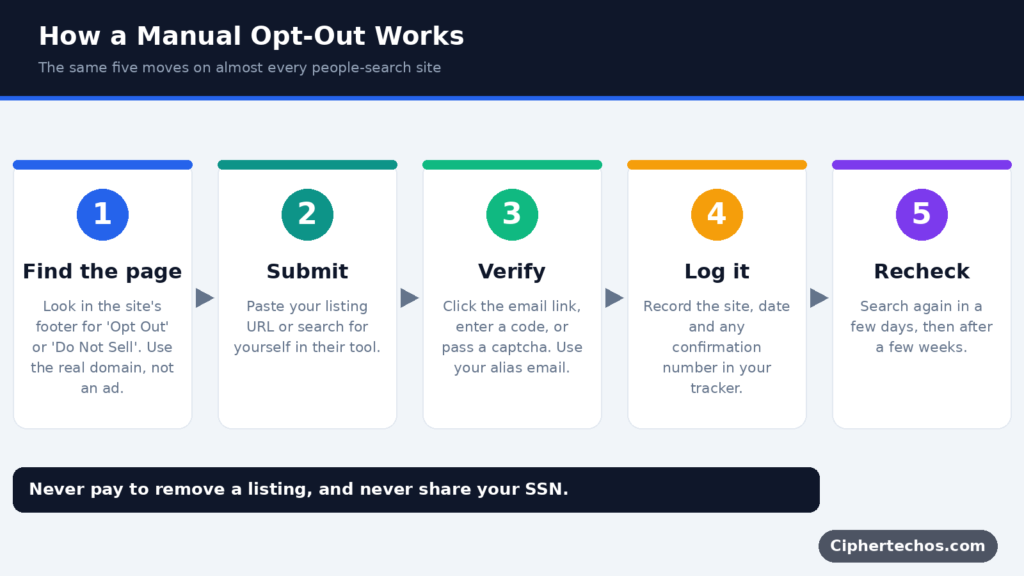
The process looks similar across most sites:
- Find the official opt-out page. Look for a link in the site’s footer labeled something like “Privacy,” “Opt Out,” “Do Not Sell My Info,” or “Remove My Listing.” If you can’t find it, search for the site’s name plus “opt out,” but go straight to the site’s own domain. Search ads and lookalike pages exist, and we’ll talk about those below.
- Submit your listing URL or your details. Some sites make you paste the link to your profile. Others ask you to search for yourself inside their opt-out tool.
- Verify. Expect an email with a confirmation link, a captcha, or occasionally a code sent to your phone. This is where your alias email and secondary number come in handy.
- Log it. Record the date and any confirmation number.
- Recheck. Search again after a few days, then after a few weeks. Some removals take effect quickly, others take a month or more.
Things that make this go more smoothly
Remove every listing, not just one. You may have separate profiles for old addresses, name variations, and typos. Each one needs its own request.
Be stingy with what you hand over. A site shouldn’t need your Social Security number, ever. A small number of sites ask for ID to verify a request. If you decide to provide one, consider covering anything they don’t strictly need, like a photo or the license number, though some will reject an image that’s too redacted. If a site demands more than seems reasonable, it’s worth pausing and weighing whether that listing is dangerous enough to justify it.
Don’t pay. Legitimate opt-outs are free. A site that tries to charge you to remove your own listing is a red flag, and any site that tries to upsell you in the middle of an opt-out is hoping you’ll give up.
Expect some friction. Consumer Reports found the hardest sites for removal services included CheckPeople, PublicDataUSA, and Intelius. If a site fights you, keep notes and consider the legal route in the next step.
Step 3: Use your legal rights
The US has no single federal privacy law that covers data brokers comprehensively, but a growing patchwork of state laws gives residents rights to access, delete, and opt out of the sale of their personal data. California has gone furthest. A quick note: what follows is general information, not legal advice, and laws change, so confirm details with your state’s official sources.
California residents: use DROP
If you live in California, there’s now a one-stop tool that can do much of the work for you. The Delete Request and Opt-out Platform, or DROP, is run by the California Privacy Protection Agency and was created under the state’s Delete Act. It lets a California resident verify eligibility, create a profile, and submit a single request that can reach more than 500 registered data brokers. Consumers have been able to submit requests since January 1, 2026, and the obligation on brokers kicked in more recently: beginning August 1, 2026, registered data brokers must access the system at least once every 45 days and process consumer deletion requests, subject to limited exceptions.
Uptake has been strong. More than 300,000 Californians signed up in the first five months, and the platform currently covers over 580 registered data brokers. One feature is especially useful: once a request goes through, brokers are meant to delete not only what they currently hold but also new information they pick up about you later.
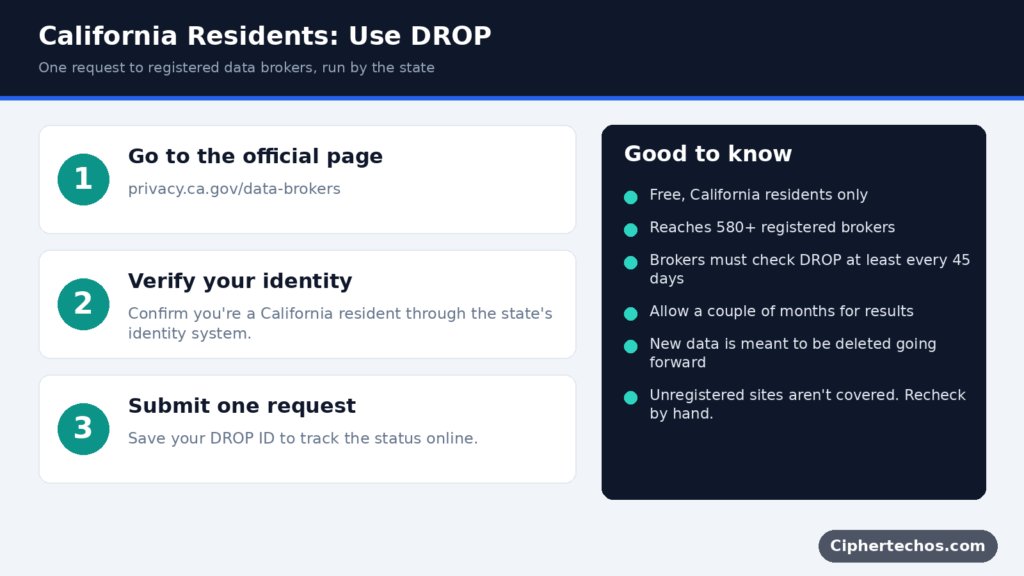
To use it, go to privacy.ca.gov/data-brokers, which is the state’s official page. You’ll verify your identity through the state’s identity system, submit the request, and receive an ID you can use to track its status. Don’t expect instant results. Brokers cycle through requests on a schedule, and at least one report puts the deletion window at up to 90 days, so give it a couple of months before judging.
A few limits to keep in mind. DROP covers brokers that are registered in California, so unregistered or offshore sites won’t be reached. The law has exceptions, so some data may stay. And it’s for California residents only. Even after you use it, run your searches again and manually handle any stubborn people-search site that still lists you.
Everyone else: state privacy laws and broker registries
If you’re outside California, there’s no central tool yet. A few other states, including Oregon, Texas, and Vermont, require data brokers to register, and their registries can help you identify who’s operating. Check your state attorney general’s website for a data broker registry or privacy guidance. Many states also have comprehensive privacy laws that let residents request deletion and opt out of sales or targeted advertising, though the details, thresholds, and exemptions differ. Because the landscape is shifting quickly, search for your state’s name plus “consumer privacy rights” to see what currently applies.
Sending your own deletion request
When a broker’s own form isn’t working, or you want a paper trail, send a written request. Most brokers list a privacy email address or web form in their privacy policy. A simple version looks like this:
Subject: Request to delete my personal information
I am a resident of [state]. Under [applicable state privacy law, or “applicable privacy laws”], I request that you delete all personal information you hold about me and stop selling or sharing it. My details so you can locate my records: [full name, current city/state, and the specific profile URL(s)]. Please confirm in writing once this is complete.
Keep it short and factual. Under California law, businesses generally have 45 days to respond to a deletion request, with an extension possible, and other states use similar timeframes. Save any reply.
If you’re in the EU or UK, you have a right to erasure under data protection law, and regulators there take broker complaints seriously.
Step 4: Handle the brokers you can’t see on Google
People-search sites are only part of the picture. A good deal of the data about you lives in marketing and verification databases that never show up in a search. You can’t scrub all of it, but you can cover some of the biggest gaps.
Stop prescreened credit and insurance offers. You can opt out through OptOutPrescreen.com or by calling 1-888-5-OPT-OUT. This doesn’t affect your credit score, and it cuts down on the unsolicited offers that carry your name and address.
Cut back on direct mail. DMAchoice lets you remove your name from many marketing mailing lists.
Register for the National Do Not Call list at donotcall.gov. It won’t stop scammers, who ignore it, but it does reduce legitimate telemarketing.
Check your consumer reports. Under federal law you can get free copies of your files from the national credit bureaus through AnnualCreditReport.com, and you’re also entitled to request your file from specialty consumer reporting agencies, which compile things like tenant screening, employment history, and insurance claims. Look for errors and dispute them.
Use opt-out rights with companies you already deal with. Many retailers, apps, and services now offer “Do Not Sell or Share My Personal Information” links. That doesn’t erase what’s already sold, but it slows the flow to brokers going forward.
Turn on Global Privacy Control. Some browsers and extensions can send this signal automatically, and in some states businesses are required to honor it as an opt-out request.
Step 5: Clean up search results and the sources feeding brokers
Even after a broker deletes your profile, a search engine may keep showing a cached copy, and the underlying source may still exist. Tackle both.
Google’s Results about you tool lets you request removal of search results that display your phone number, home address, or email, along with certain ID numbers. The order matters: get the broker to delete the listing first, then ask Google to remove or refresh the result. If you only remove it from Google, the page stays live on the broker’s site and can be found in other ways. Bing also has its own removal request process.
Look at your own footprint. Old social media profiles, forum accounts, school or club directories, and online petitions can all hand brokers data that’s easy to scrape. Delete accounts you don’t use and tighten the privacy settings on the ones you keep.
Think about public records. This is the hard part. Property records, court filings, business registrations, and, in some states, voter rolls are legally public. Options vary widely by state and situation, but some people reduce exposure by using a PO box or commercial mail address where the rules allow, registering a business with a registered agent rather than a home address, or asking about holding property through a trust or LLC (talk to a lawyer before doing this). Many states run address confidentiality programs for survivors of domestic violence, stalking, and similar situations, and some states have laws protecting judges, law enforcement officers, and other officials, such as New Jersey’s Daniel’s Law. If you may qualify, those programs are worth a serious look.
Step 6: Stop your data from coming back
Opting out gets you clean. Keeping clean is a habit.
Use aliases. An email masking service, a secondary phone number for forms, and a mailbox that isn’t your home address mean the data brokers collect gets matched to something other than your real identity.
Skip optional fields. Birthday, phone number, and income range on sign-up forms are frequently optional, and each one adds to your file.
Be selective with loyalty programs, warranty cards, sweepstakes, and free quizzes. These are classic data sources. Ask yourself whether the discount is worth the profile.
Check your phone’s privacy settings. Turn off the advertising ID, limit app tracking, and review which apps can see your location. Location data is one of the more valuable things brokers resell.
Freeze your credit. A freeze at Equifax, Experian, and TransUnion is free and blocks new accounts from being opened in your name. It won’t remove your data from brokers, but it takes a lot of the sting out of identity theft if your details do get misused.
Schedule rechecks. Put a reminder on your calendar to search yourself again every three months during the first year, then every six months. Update your spreadsheet each time. When a listing reappears, resubmit the opt-out and note how long it took.
Should you pay for a data removal service?
Services like DeleteMe, Optery, Incogni, Kanary, and others will submit opt-out requests for you and keep checking. The pitch is simple: your time is worth more than the subscription. Prices vary, and Consumer Reports found them ranging from $19.99 to $249 per year.
The more important question is whether they work. The 2024 Consumer Reports study is the best independent evidence available, and the results were underwhelming. Researchers tested seven services across 13 people-search sites. Of the 332 instances of participants’ information they initially found, only 117, or 35%, were removed within four months. Results varied between services, and some people-search sites responded to requests more readily than others. The researchers also noted that some removal services advertise on or partner with the very people-search sites they’re supposed to be fighting, which is worth keeping in mind when you read reviews.
Those findings are from 2024, and the services and the laws have both changed since, so treat it as a data point, not a verdict. Still, here’s what I’d take from it.
A paid service can make sense if you don’t have the time or patience, if you want ongoing monitoring, or if you’d rather pay for the repetitive work of rechecking. It tends to be most useful as upkeep after you’ve done the heavy lifting.
A hybrid approach is often smartest. Handle the most dangerous people-search sites yourself, use DROP if you’re in California, and consider a service for monitoring and the long tail of smaller sites.
If you do hire one, read its privacy policy to see what it does with the information you give it (you’re handing over your name, address, and email, after all), ask which sites it covers and how often it checks, look for any ownership or partnership ties to people-search sites, and be wary of anything that guarantees complete removal.
If you’re being stalked or harassed
If someone is actively targeting you, the order of operations changes. Start with the people-search sites that show your current address, and get those down first. Include other members of your household, since their profiles may list you as a relative. Document everything, report threats to the police, and consider contacting a local victim advocacy organization, which can help with safety planning and often knows about address confidentiality programs and legal protections in your area. If handling opt-outs yourself feels overwhelming, ask someone you trust to take on part of the work. You don’t need to do it alone.
Mistakes and scams to avoid
Fake opt-out pages. Scammers sometimes build lookalike sites or buy search ads to intercept people searching for “[site] opt out.” Always navigate from the broker’s real website, and check the web address before typing anything in.
Paying to remove a listing. If a page asks for payment to delete your own data, close it.
Handing over sensitive identifiers. No legitimate opt-out requires your Social Security number or financial account details.
Unsolicited “we’ll remove you for a fee” messages. Emails or calls claiming your data is exposed and offering immediate removal for a price are frequently scams. Reach out to services yourself rather than responding to cold contact.
Giving up after the first round. Some people opt out, never check, and assume it’s done. The profile reappears six months later and they never know.
Frequently asked questions
Is it legal for data brokers to sell my information?
In most of the United States, largely yes, especially information drawn from public records, though the rules are tightening state by state. Some uses are restricted: if data is used to decide things like employment, housing, or credit, federal consumer reporting rules may apply. The law differs by state and by broker type.
How long does removal take?
It varies. Many people-search sites process an opt-out within days to a few weeks, and Consumer Reports found a large share of manual opt-outs were gone within a week. Formal deletion requests under state law can take longer, and DROP requests can run a couple of months.
Will opting out affect my credit score or my ability to get a loan?
No. People-search sites and marketing lists aren’t your credit reports. Opting out doesn’t change your credit file, your score, or your eligibility for credit, insurance, or housing.
Will my information come back?
Often, yes, which is why rechecking matters. Brokers pull in fresh records regularly, so a removed profile can reappear. A recurring check every few months catches it early.
Do I need to do this for my family?
Ideally, yes, at least for adults in your household and any elderly relatives. Profiles are interconnected, and a relative’s listing may show your address or name. For minors, check whether any sites list them, and use the same opt-out process on their behalf.
Can I just remove my information from Google and be done?
No. That hides the result from search, but the page still exists on the broker’s site and can be reached directly or through other search tools. Remove the source first, then the search result.
Is the effort really worth it if I can’t get to 100%?
Yes. Getting your address and phone number off the most visible sites eliminates the easiest routes for casual snooping, scams, and harassment. You’re not aiming for invisibility. You’re aiming for enough friction that most people will give up.
What You Need to Remember
Data brokers have spent years building profiles on people who never agreed to be profiled, and cleaning that up takes real effort. But it’s a manageable project once you break it into pieces: find your listings, opt out of the major people-search sites, use your legal rights (and DROP if you’re in California), clean up search results, shut off the sources feeding the machine, and set a reminder to check again.
Start with the five sites that show up first when you search your own name. Do those this weekend. Then work outward from there. A small amount of effort now makes you meaningfully harder to find, track, and target, and that’s worth having.