It starts with a message that seems harmless. A friendly stranger texts a “wrong number” and, a few days later, you are chatting like old friends. They mention that they have been making steady profits trading cryptocurrency on a platform that a relative taught them to use. You are curious. They offer to show you. You deposit a small amount, watch it grow on a slick dashboard and withdraw a little as a test. It works.
So you put in more. And more. Then the balance on your screen climbs to six figures, and when you try to withdraw it, you are told you must first pay “taxes” or a “verification fee.” The platform was never real. The profits were numbers on a screen. And the friend has vanished.
This is just one of the ways fake crypto investments separate people from their money. Others include rug pulls, fake exchanges, wallet drainers, giveaway scams and Ponzi schemes dressed in blockchain language. In this guide you will learn the rug pull meaning, how the main schemes work, and the eight most reliable crypto scam signs, plus a due diligence checklist and clear steps to take if you have already been caught.
This article is educational and is not financial advice. Cryptocurrency is volatile and high risk even when no fraud is involved.
What Are the Warning Signs of a Crypto Scam?
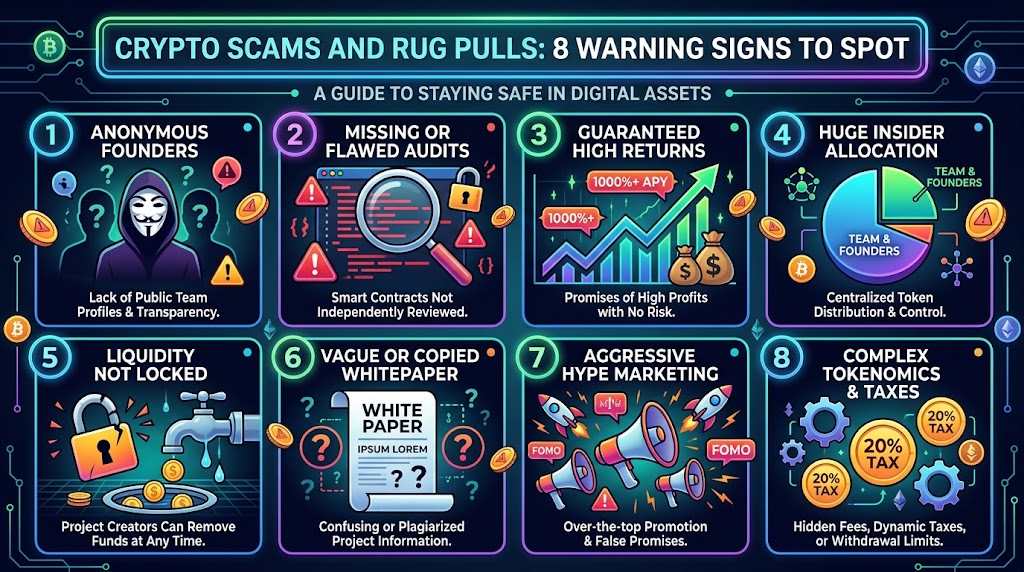
The eight most common crypto scam signs are:
- Guaranteed or unusually high returns with little or no risk
- Pressure to act fast and fear of missing out
- Unsolicited contact from a stranger, or a new online romance that turns to investing
- Anonymous teams, vague projects and fake credentials
- Difficulty withdrawing, or demands for extra fees to release your money
- Requests to send crypto first, or to move funds to an unfamiliar wallet or platform
- Suspicious token mechanics, such as unlocked liquidity, concentrated ownership or a token you cannot sell
- Celebrity endorsements and social media hype that cannot be verified
If you see even one of these, stop and investigate before sending anything. If you see several, assume it is a scam.
Key Takeaways
- A rug pull is a scam in which the creators of a crypto project attract investors and then abandon it, taking the money.
- Scammers target your emotions: greed, fear of missing out, loneliness and trust.
- Transactions are usually irreversible, so prevention matters far more than recovery.
- No legitimate investment can guarantee profits, and no real authority asks you to pay a fee to release your funds.
- You can lower your risk with simple checks, secure wallet habits and a rule never to invest because a stranger suggested it.
Why Crypto Is a Scammer’s Playground
Cryptocurrency itself is not a scam. Blockchains are real technology, and many projects and businesses are legitimate. But several features of the crypto world make it fertile ground for fraud:
- Irreversible transactions. Once you send crypto, there is generally no bank to call and no chargeback.
- Pseudonymity. Wallet addresses do not carry names, and scammers can move funds quickly across borders and wallets.
- Low barriers to entry. Anyone can create a token in minutes, with almost no cost, and list it for trading.
- Patchy regulation. Rules vary by country and are still evolving. Many platforms and tokens operate with little oversight.
- Hype and complexity. Technical language and stories of overnight fortunes make it hard for newcomers to separate genuine innovation from fiction.
- Social media reach. Scammers can build convincing communities, fake followers and fake testimonials cheaply.
The scale of losses is significant. The FBI’s Internet Crime Complaint Center has reported crypto-related fraud losses in the billions of dollars each year in the United States alone, with investment scams making up the largest share. Consumer protection agencies in many other countries report similar trends.
The Main Types of Crypto Scams
Before looking at the warning signs, it helps to know the common scams.
Rug pulls
Project creators hype a new token or platform, attract buyers, then drain the funds and disappear. Explained in detail in the next section.
“Pig butchering” and romance investment scams
A scammer builds a relationship over days or weeks, often through a dating app, social media or a text message sent to a “wrong number.” Once trust is established, they steer the conversation toward cryptocurrency investment on a fake trading platform. The victim sees profits on screen, is encouraged to invest more, and finally discovers that withdrawals are blocked. The term “pig butchering” refers to the idea of fattening the victim before the slaughter. Law enforcement agencies worldwide have warned about these operations, many of which are run by organized criminal groups.
Fake exchanges and trading apps
Websites and mobile apps that mimic real exchanges or invent new ones. They show fake balances and fake trading activity but do not actually invest your money.
Ponzi and pyramid schemes
Schemes that promise high returns, paid to early investors using money from newer ones, often with referral bonuses for recruiting others. They collapse when new money stops arriving.
Giveaway and impersonation scams
Fake social media posts, videos or livestreams, often using the name or deepfake likeness of well-known figures, promise to “double” any crypto you send. You send crypto and receive nothing.
Phishing and wallet drainers
Fake websites, emails, messages and ads trick you into entering your seed phrase or approving a malicious transaction that gives the attacker permission to empty your wallet.
Fake airdrops and NFT scams
You receive unexpected tokens or an offer of a free NFT or airdrop. Interacting with them connects your wallet to a malicious contract.
Address poisoning
Scammers send tiny transactions from addresses that look similar to ones you have used, hoping you will copy the wrong address from your transaction history when sending funds later.
Pump-and-dump schemes
Organizers promote a low-value coin to inflate its price, then sell their holdings at the peak, leaving latecomers with losses.
Fake support and recovery services
Impersonators posing as exchange or wallet support ask for your seed phrase or remote access. Others offer to recover lost crypto for a fee. These are scams too.
Crypto ATM and payment scams
Fraudsters instruct victims, often older adults, to withdraw cash and deposit it into a crypto ATM to pay a supposed debt, fine or “safe account.” Legitimate government agencies and companies do not request payment this way.
What Is a Rug Pull?
The rug pull meaning is simple: the developers “pull the rug out” from under investors. They launch a crypto token or decentralized finance (DeFi) project, generate excitement and attract money, then abruptly withdraw the funds and abandon the project. The token’s price collapses to near zero, and investors are left holding worthless assets.
How rug pulls work
There are two broad forms:
Hard rug pulls involve a deliberate technical trap built into the project:
- Liquidity theft: Trading on decentralized exchanges depends on a pool of funds, called liquidity, that buyers and sellers trade against. If the creators control that pool and have not locked it, they can remove it all at once, leaving no value for holders.
- Honeypot contracts: The token’s code lets people buy but blocks others from selling, so only the creators can cash out.
- Hidden backdoors: The smart contract includes hidden functions that let the owner mint unlimited new tokens, change fees to nearly 100% or seize holders’ funds.
Soft rug pulls involve no obvious code trick. The team simply sells its large holdings into the hype, stops communicating, deletes social accounts and moves on, while the project quietly dies.
A related pattern is the exit scam, in which a platform collects deposits for months or years and then disappears with the funds.
Why rug pulls are common
Anyone can create and launch a token cheaply, promote it through social media and influencers, and benefit from the speculative frenzy that often surrounds new coins. Many buyers do not read the code or verify who is behind the project. Because DeFi platforms are often permissionless and anonymous, there is no one to hold accountable.
Not every failed project is a rug pull. Many crypto ventures fail through bad management or market conditions. But when the pattern includes deception, hidden controls and a sudden disappearance, it is fraud.
The 8 Warning Signs of a Crypto Scam
Warning sign 1: Guaranteed or unusually high returns
What it looks like: “Earn 2% a day, guaranteed.” “Risk-free profit.” “Double your Bitcoin in 24 hours.” “Our AI trading bot never loses.”
Why it is a red flag: Every genuine investment carries risk, and crypto is among the riskiest. Legitimate firms are legally prohibited in many places from guaranteeing returns. Extraordinarily high, steady returns are the signature of Ponzi schemes and fake platforms, which show good numbers to lure more deposits.
What to do: Treat any guarantee as an automatic disqualifier. If returns seem far above what regulated products offer, with no corresponding risk, walk away.
Warning sign 2: Pressure to act fast and fear of missing out
What it looks like: “Only 24 hours left.” “Presale ends tonight.” “Whales are buying, get in now.” Countdown timers, limited slots and messages that you will regret waiting.
Why it is a red flag: Urgency stops you from researching, asking questions or consulting someone. Scammers know that fear of missing out is a powerful emotion, especially when prices are rising and stories of overnight millionaires are everywhere.
What to do: Take the pressure as proof that something is wrong. A legitimate opportunity will still be there tomorrow. Give yourself a mandatory waiting period, such as 48 hours, before sending money to any new platform or token.
Warning sign 3: Unsolicited contact or a new online relationship that turns to investing
What it looks like: A stranger messages you on social media, a dating app, a messaging service or by “wrong number” text. They are friendly, attractive and successful. Soon they mention a trading platform or a “mentor” who gives insider tips. They may encourage you to move the conversation to a private messaging app.
Why it is a red flag: Genuine friends and partners do not ask you to invest through a platform you have never heard of. This pattern is the core of pig butchering scams. The relationship is a tool for lowering your guard.
What to do: Never invest because someone you met online told you to. Be wary of any new contact who steers the conversation to money, crypto or trading, especially if you have not met in person or on a live video call. If you are curious, do your own research independently and consult a registered financial professional.
Warning sign 4: Anonymous teams, vague projects and fake credentials
What it looks like: No named founders, or founders with stock photos and invented résumés. A “whitepaper” full of buzzwords but no clear explanation of how the project makes money. A website created weeks ago. Plagiarized documents. Claims of partnerships with major companies that cannot be verified.
Why it is a red flag: If no accountable people are behind a project, no one can be held responsible when it fails. Fake credentials are designed to build false trust.
What to do: Search for the founders independently and confirm their identities through reliable sources. Check whether claimed partners actually mention the project on their own official sites. Look for independent security audits from reputable firms, and verify them with the audit firm directly. Be cautious: a scam can fake an audit certificate.
Warning sign 5: Trouble withdrawing, or demands for extra fees
What it looks like: Your balance on the platform keeps growing, but when you try to withdraw, you are asked to pay a “tax,” “unlock fee,” “insurance deposit,” “anti-money-laundering verification” or “upgrade fee.” Withdrawals are delayed, support stops answering or your account is suddenly “frozen.”
Why it is a red flag: Legitimate platforms deduct fees from your balance. They do not require you to send more money to access your own funds. This is the classic ending of fake trading platforms, and every additional payment is simply lost.
What to do: Never pay a fee to release your money. If you cannot withdraw, stop depositing. Withdraw what you can, and document everything. Test withdrawals early on any new platform, and remember that a successful small withdrawal does not prove safety, because scammers often allow small ones to build trust.
Warning sign 6: Requests to send crypto first
What it looks like: “Send 0.5 ETH and receive 1 ETH back.” Instructions to move funds to an “official” or “secure” wallet. A demand to convert your savings to crypto and send it to someone else. A “government agent,” “bank fraud officer” or “customer support representative” who asks you to deposit cash in a crypto ATM.
Why it is a red flag: There is no legitimate reason to send crypto to receive crypto, and no real government agency, bank or business will ask you to pay or protect your money through crypto transfers. Because transactions are irreversible, this is the most direct route for theft.
What to do: Never send funds to anyone who contacted you. Never share your seed phrase or private keys with anyone, including “support staff.” Verify any request through official channels you find yourself. Be especially suspicious of anyone who tells you to lie to your bank or to keep the transaction secret.
Warning sign 7: Suspicious token mechanics
What it looks like: Features that suggest a rug pull is possible:
- Liquidity is not locked, meaning the creators can remove it whenever they like
- A few wallets hold most of the supply, so they can crash the price by selling
- You can buy but cannot sell, or sales fail unexpectedly
- Very high or changeable buy and sell taxes
- The contract owner retains special privileges, such as minting new tokens, pausing trading or blacklisting wallets
- The contract code is not verified on the blockchain explorer
- A brand-new token with sudden, unexplained price surges and volume driven by a handful of wallets
Why it is a red flag: These traits are how hard rug pulls are engineered. They give a small group the power to extract value at everyone else’s expense.
What to do: Before buying a new token, use a block explorer to check the contract and the distribution of holdings, and use reputable token analysis tools to look for locked liquidity and suspicious functions. Be aware that these tools are not foolproof. If you cannot understand how a token works, or what the owner can do, treat that as a reason not to invest. A tiny test purchase and sale can reveal honeypots, but it does not guarantee safety.
Warning sign 8: Celebrity endorsements and social media hype you cannot verify
What it looks like: A video of a famous entrepreneur promoting a crypto giveaway. A post claiming a well-known investor is backing a coin. A flood of enthusiastic comments from accounts that appear days old. Influencers promoting a token without disclosing payment. Livestreams that replay old footage with a scam QR code.
Why it is a red flag: Scammers routinely hijack famous names, hack verified accounts, and use deepfakes and fake news articles to make a scheme look credible. Many genuine influencers have also been paid to promote tokens they know little about, and some of those tokens turned out to be scams.
What to do: Check celebrity claims on the person’s own verified, official channels. Treat any “giveaway” that requires you to send crypto first as fraud. Ignore comment sections, which are easily faked. Remember that a famous name is not due diligence.
Real-World Cases
These cases come from public reporting and court records.
OneCoin
OneCoin was marketed in the mid-2010s as a revolutionary cryptocurrency, but prosecutors said it had no real blockchain and operated as a massive fraud that took billions of dollars from investors worldwide. Its co-founder Karl Sebastian Greenwood was sentenced in the United States, and its other co-founder, Ruja Ignatova, disappeared in 2017 and has been sought by authorities since. OneCoin shows how a convincing story, events and multi-level recruitment can sustain a scam for years.
BitConnect
BitConnect promised extraordinary monthly returns through a supposed trading bot and a lending program, backed by an aggressive referral network. It collapsed in early 2018 after regulators issued warnings and its lending program was shut down, and its token plunged. U.S. authorities later brought criminal and civil cases linked to the scheme.
The Squid Game token (2021)
A token capitalizing on the popularity of a Netflix series rose dramatically in value in late October 2021. Buyers soon discovered that they could not sell it, a classic honeypot trait, and the developers disappeared, taking an estimated several million dollars. The case showed that borrowing a famous name, buzz and a social media community can mask a trap.
Thodex (2021)
The Turkish exchange Thodex suddenly halted operations in April 2021, and its founder left the country, leaving customers unable to withdraw funds. It illustrated the risk of leaving large sums on an unregulated platform.
FTX (2022)
FTX, once one of the largest crypto exchanges, collapsed in November 2022 after it emerged that customer funds had been used improperly. Its founder, Sam Bankman-Fried, was convicted of fraud in 2023. FTX was not an anonymous rug pull, but it showed that slick marketing, famous endorsements and big-name investors do not guarantee that customer funds are safe.
Pig butchering at scale
Law enforcement agencies in multiple countries have warned about, and seized funds from, organized operations running romance-investment scams, and researchers have documented that some are run from compounds where workers are themselves victims of trafficking. U.S. authorities have announced large cryptocurrency seizures connected to such schemes.
What these cases teach
- Scams can last years if the story keeps new money coming in.
- Famous names, big events and polished websites are not proof of legitimacy.
- The inability to withdraw is the clearest sign of trouble.
- Keeping funds on unregulated platforms creates risk even without fraud.
A Due Diligence Checklist Before You Invest
Use these questions to examine any crypto project, platform or opportunity. Answering “no” or “I don’t know” to several is a signal to stay out.
The people
- Are the founders and team publicly named, with verifiable histories?
- Can you confirm their identities and past work through independent sources?
- Did the offer come from a stranger or an unverified account?
The platform
- Is the exchange or platform registered or licensed in a recognized jurisdiction? Check the regulator’s official register, not the claim on the website.
- Has the web address been checked carefully for lookalikes?
- How old is the website, and what do independent reviews and regulator warning lists say?
- Can you withdraw funds easily, and what are the published fees?
- Does the app come from an official app store listing by a known developer?
The project
- Can you explain in plain language how it makes money or creates value?
- Is the whitepaper original and clear, or full of buzzwords and copied text?
- Is there a working product, not just a roadmap?
- Has the code been independently audited by a reputable firm, and can you confirm the audit with that firm?
The token
- Is the contract verified and viewable on a block explorer?
- Is liquidity locked, and for how long?
- How is the supply distributed, and do a few wallets hold most of it?
- Does the owner retain powers to mint tokens, change fees or block sales?
The offer
- Does it promise guaranteed or very high returns?
- Is there pressure to act quickly or to keep it secret?
- Are you being asked to send crypto to someone else, or to pay a fee to withdraw?
- Would you be comfortable explaining the investment to a skeptical friend or a qualified adviser?
Your own limits
- Are you investing only money you can afford to lose entirely?
- Have you waited at least a couple of days before committing?
- Have you told a trusted person what you are doing?
How to Protect Your Wallet and Accounts
Even if you avoid scam investments, you can still lose crypto through theft. These habits reduce the risk.
- Never share your seed phrase or private keys. No legitimate wallet, exchange or support agent will ever ask for them. Anyone who has them can take everything.
- Store your seed phrase offline, on paper or metal, in a secure place, not in a photo, email or cloud note.
- Use a hardware wallet for significant holdings, and buy it directly from the manufacturer.
- Use strong, unique passwords and a password manager, and turn on multi-factor authentication on every exchange account, preferably with an authenticator app or security key rather than SMS.
- Type or bookmark exchange and wallet addresses. Never click links from ads, direct messages or emails.
- Verify wallet addresses character by character before sending, and send a small test transaction first for large transfers.
- Review and revoke token approvals you have given to smart contracts, which can otherwise let a malicious contract spend your tokens.
- Be careful with unsolicited tokens and NFTs. Do not interact with them, approve them or try to sell them.
- Use a separate wallet for experimenting with new apps and keep long-term holdings elsewhere.
- Keep your device secure, with updates, reputable security software and caution with downloads and browser extensions.
- Ignore private messages offering help. Scammers monitor support channels and public forums and send direct messages posing as helpers.
- Do not move funds in response to urgent warnings, such as a message saying your wallet is compromised.
What to Do If You Have Been Scammed
Strong feelings of shame are common, but fraud is a crime, and the people who run these schemes are professionals. Take these steps as soon as you realize something is wrong.
- Stop sending money. Do not pay any further “fees,” “taxes” or “unlock” payments. They will not release your funds.
- Cut contact with the scammer, but save everything: messages, wallet addresses, transaction hashes, website addresses, screenshots, emails and payment records.
- Contact your exchange or payment provider immediately if funds went through one. Report the transaction and ask whether they can flag the destination address or freeze funds. Quick action sometimes helps.
- Contact your bank or card issuer if you used a card or bank transfer. They may be able to dispute or recall payments.
- Secure your accounts and wallets. If you shared a seed phrase, entered it on a fake site or granted approvals, move any remaining funds to a new wallet created on a clean device, and revoke approvals. Change passwords and enable MFA.
- Report the scam. In the United States, report to the FBI’s IC3 at ic3.gov and the FTC at reportfraud.ftc.gov. You can also report to the Commodity Futures Trading Commission or the Securities and Exchange Commission, and to your state securities regulator. In other countries, contact your national financial regulator, police cybercrime unit or consumer agency.
- Report to the platform where you met the scammer, such as the social media or dating site, and to any exchange that received the funds.
- Warn others, including family and friends, and consider telling your community. Scammers rely on silence.
- Keep records for taxes and legal advice. Depending on where you live, theft losses may have tax implications. Consult a qualified professional.
- Look after yourself. Financial fraud takes an emotional toll. Talk to someone you trust, and consider support from a counselor or a fraud victim support organization.
Beware of Recovery Scams
After you report a loss, you may be contacted by people who promise to recover your crypto. They may claim to be lawyers, blockchain forensics experts, government agents or hackers who can “trace” the thieves. They often appear in comment sections, messaging apps and search ads, or contact you directly after you post about your loss.
Red flags include:
- Upfront fees, deposits or a percentage of the recovered amount paid in advance
- Guarantees of recovery
- Requests for your seed phrase, remote access or banking login
- Pressure to act fast
- Contact that you did not request
Genuine law enforcement agencies do not charge victims to investigate or recover funds, and they do not cold-contact victims promising to retrieve crypto for a fee. Verify any service independently, and be skeptical of anyone who guarantees results.
Frequently Asked Questions
What is the rug pull meaning in crypto?
A rug pull is a scam in which the creators of a crypto project attract investors, then withdraw the funds and abandon the project, leaving the token worthless. It can involve hidden code that prevents selling or draining of liquidity, or simply a team dumping its tokens and disappearing.
How can I tell if a crypto token is a rug pull?
Look for anonymous creators, unlocked liquidity, a handful of wallets holding most of the supply, unverified contract code, owner powers to mint or block sales, extreme hype and an inability to sell. No single check is perfect, and many rug pulls only show their hand after money has gone in.
Are all new cryptocurrencies scams?
No. Many are legitimate experiments, but new, unaudited tokens are extremely high risk, and scams are common among them. Even honest projects can fail. Only invest what you can afford to lose.
What is a pig butchering scam?
It is a long-con fraud in which scammers build a relationship with a victim, usually online, then persuade them to invest in a fake crypto platform. The victim sees fake profits, deposits more, and eventually cannot withdraw. The term comes from “fattening” the victim before the theft.
Can stolen crypto be recovered?
Sometimes, but it is difficult. Blockchain transactions are irreversible, and scammers move funds quickly. Reporting promptly to exchanges and law enforcement gives the best chance, particularly if funds reach a regulated exchange that can freeze them. Be wary of anyone who guarantees recovery.
Is it safe to invest in crypto through a friend’s recommendation?
A friend can be honest and still wrong, or their account may have been hacked or impersonated. Do your own research, verify the platform and invest only what you can afford to lose. If the friend is someone you have only met online, treat the recommendation as a warning sign.
How do I know if a crypto exchange is legitimate?
Check whether it is registered or licensed with a financial regulator in a jurisdiction you recognize, using the regulator’s official register. Look for a clear company address and leadership, a record of operating, transparent fees and withdrawal policies, and independent reviews. Be cautious of platforms that you cannot withdraw from or that nobody can verify.
Do crypto giveaways from celebrities ever work?
No. Any giveaway that asks you to send crypto first to receive more is a scam. Fraudsters hijack famous accounts and use fake videos to make them convincing.
What should I do if a “support agent” asks for my seed phrase?
Refuse and end contact. No genuine wallet or exchange will ever ask for your seed phrase or private keys. Anyone who gets them can take all your funds.
Are crypto ATMs safe?
They are legal in many places but widely used in scams. Never use one because someone told you to, whether a caller claiming to be from a government agency, a bank, a utility or a tech support company. No legitimate organization demands payment through a crypto ATM.
Is crypto investment regulated?
It depends on the country and the type of asset or service. Some activities are regulated, while others fall into gray areas. Lack of regulation means fewer protections if something goes wrong, so verify the status of any platform you use.
Conclusion
The crypto world rewards curiosity, but it punishes haste. The most dangerous moment in any scam is the one in which you feel excited, rushed or flattered, because that is when careful questions disappear.
Keep the eight signs in mind. Guaranteed returns. Pressure and fear of missing out. A stranger who becomes a trusted friend and then talks about investing. Anonymous teams and vague promises. Extra fees to withdraw your own money. Requests to send crypto first. Token mechanics that let insiders cash out while you cannot. Endorsements that you cannot verify. Any one of these should make you stop. Several together should make you walk away.
Because crypto transactions are so hard to reverse, your best protection is the pause before you click “send.” Use that pause to verify, to ask a trusted person and to remember a simple rule: if it sounds too good to be true, and a stranger or an anonymous token is asking for your money, it almost certainly is.